Financing available. Click here to learn more ⟶
Financing available. Click here to learn more ⟶
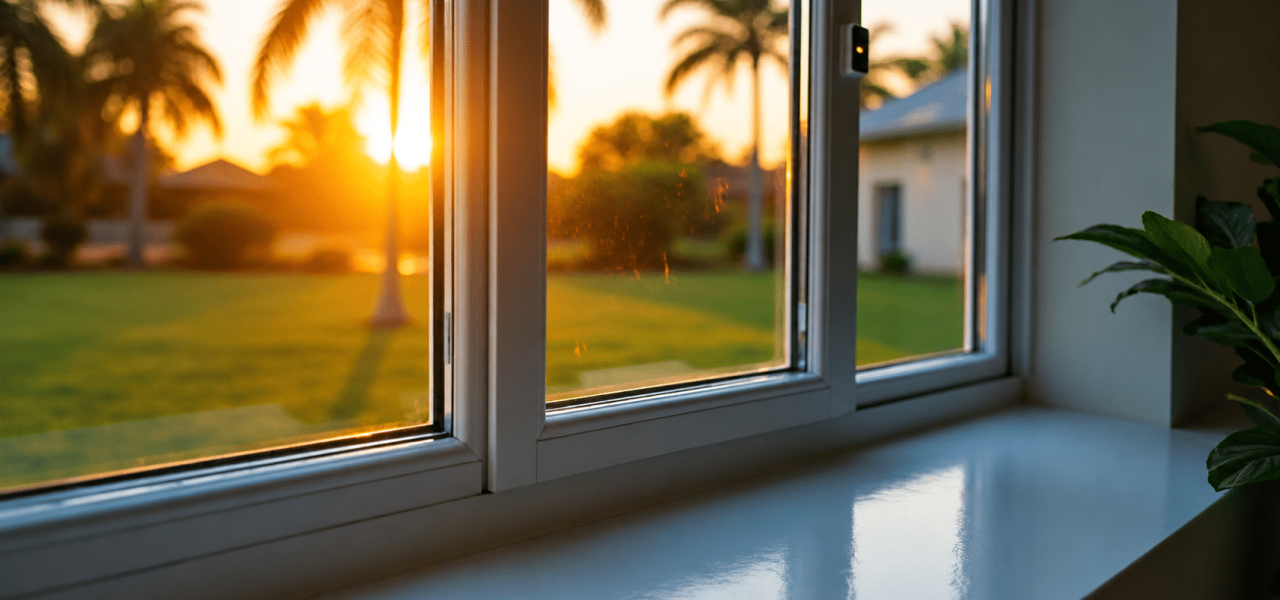
Energy-efficient windows installed in a Florida home — designed to reflect heat, not retain it.
If you live in Florida, your air conditioner is the single biggest contributor to your electric bill, and your windows are a big part of why it works so hard. Standard windows that perform fine in Ohio or Pennsylvania can cost you hundreds of dollars a year here, because they were never designed for 90-degree summers, 80% humidity, and the kind of UV exposure that fades furniture in a single season.
In simple terms, an energy-efficient window keeps heat out of your house in summer and (less critical here) keeps it in during the few cold weeks of winter. It does this through a combination of multiple panes of glass, special coatings, insulating gas between the panes, and a tightly sealed frame.
In Florida, the priority is heat rejection. Anywhere north of about Atlanta, manufacturers tune their windows to retain interior heat. In Florida, you want the opposite; windows tuned to reflect solar heat outside before it ever enters your home. That’s why a window labeled “energy-efficient” in a national catalog might still underperform here. The label is meaningful only when the underlying ratings are calibrated for our climate zone.
The good news: those ratings are standardized and easy to read once you know what they are. Every legitimate energy-efficient window comes with a National Fenestration Rating Council (NFRC) label that tells you exactly how it will perform.
Three climate factors make Florida home windows a special case:
• Sustained heat: Summer temperatures regularly exceed 90°F for months at a time. Your HVAC fights heat almost year-round, unlike northern climates that cycle between heating and cooling.
• Extreme humidity: Average humidity sits between 70% and 80%, especially along the Gulf Coast in cities like Tampa. Windows that aren’t sealed properly let moist air seep in, which forces your AC to work harder on dehumidification, one of the most energy-intensive things it does.
• Intense solar radiation: Florida ranks among the highest U.S. states for solar radiation. Sun pouring through ordinary glass can raise indoor temperatures by 10–15 degrees in a sunlit room and fade hardwood floors, fabric, and artwork.
Standard windows weren’t engineered for this combination. That’s the whole reason “energy-efficient windows in Florida” is its own category: what works in the Northeast actively underperforms in St. Petersburg, Miami, or Jacksonville.
Window manufacturers love marketing language. Here are the four specs that determine real-world performance in Florida, these are what to ask about when you request a quote.
Low-E coatings are microscopically thin layers of metallic oxide applied to the glass. They reflect infrared heat (the part of sunlight that warms your home) while letting visible light through. For Florida, ask specifically for a ‘southern climate’ Low-E coating, these are tuned to block heat aggressively, unlike northern Low-E coatings, that try to retain interior heat.
U-factor measures how well a window resists heat flow. A lower u-factor means better insulation. For Florida, target a u-factor of 0.30 or lower. ENERGY STAR’s most efficient windows for the Southern Climate Zone hit 0.27 or below.
SHGC measures how much solar heat actually passes through the window. In Florida, this matters more than u-factor for most homes. Aim for SHGC between 0.25 and 0.30. Anything above 0.40 is wrong for our climate, no matter how the salesperson markets it.
Energy-efficient windows seal an inert gas (usually argon, sometimes krypton for premium products) between the panes instead of plain air. These gases are denser than air and slow heat transfer dramatically. Krypton performs slightly better than argon, but costs more. Argon is the sweet spot for most Florida homes.
Some window styles handle Florida’s climate better than others. Here’s how the most common types stack up:
• Casement windows: The crank-out design creates the tightest seal of any operable window, best raw energy efficiency.
• Single-hung and double-hung: The classic choice for Florida home windows. Modern versions with quality weatherstripping perform well and offer the most familiar look.
• Sliding windows: Practical for wide openings and great for bedrooms or coastal-facing rooms in places like Clearwater. Choose models with multi-point locks for the best seal.
• Awning windows: Open outward and upward, letting you ventilate even during light rain without losing your AC.
• Impact-resistant windows: Required by code in Miami-Dade and Broward (the High-Velocity Hurricane Zone) and along most of Florida’s coast as part of wind-borne debris regions. Even where they’re not required, they often pay off through insurance discounts and the laminated glass naturally provides better insulation.
Windows account for up to 30% of a home’s heating and cooling energy use. According to the U.S. Department of Energy, replacing single-pane windows with energy-efficient models saves between 12% and 33% on annual energy bills.
In Florida, where cooling drives the bulk of your electric bill year-round, those percentages translate to real numbers:
• $200–$400 per year: Typical savings for a basic single-pane to double-pane upgrade in an average-sized Florida home.
• Add 10–20% on top: When you include Low-E coatings and inert gas fills.
• $500+ per year: Realistic for larger homes or older window stock, a Sarasota or Orlando customer with 1980s-era windows often sees savings well above this.
The full ROI picture goes beyond the monthly bill. Florida homeowners typically recover 20–30% of the window cost through energy savings within 5–10 years. On top of that, energy-efficient upgrades add 5–15% to home value at resale. Combine the savings, the resale lift, the lower insurance premiums (especially if you go impact-rated), and the comfort difference, and the math is consistently favorable.
Some window styles handle Florida’s climate better than others. Here’s how the most common types stack up:
• Casement windows: The crank-out design creates the tightest seal of any operable window, best raw energy efficiency.
• Single-hung and double-hung: The classic choice for Florida home windows. Modern versions with quality weatherstripping perform well and offer the most familiar look.
• Sliding windows: Practical for wide openings and great for bedrooms or coastal-facing rooms in places like Clearwater. Choose models with multi-point locks for the best seal.
• Awning windows: Open outward and upward, letting you ventilate even during light rain without losing your AC.
• Impact-resistant windows: Required by code in Miami-Dade and Broward (the High-Velocity Hurricane Zone) and along most of Florida’s coast as part of wind-borne debris regions. Even where they’re not required, they often pay off through insurance discounts and the laminated glass naturally provides better insulation.
A few shifts have happened in the Florida window market over the last couple of years that are worth flagging:
• Triple-pane is gaining ground: Once considered overkill for Florida, triple-pane windows with proper southern-climate Low-E coatings now make sense for premium new construction and high-energy-cost homes, particularly in markets like Jacksonville, where cooling costs are high, but heating costs aren’t trivial.
• Smart glass is moving from luxury to mainstream: Electrochromic glass that tints automatically based on sun exposure has dropped in price enough that it’s appearing in mid-market projects, not just custom builds.
• Slim-frame designs: Modern aesthetics demand more glass and less frame, and manufacturers have responded with slim-profile aluminum and fiberglass frames that don’t sacrifice insulation.
• Federal energy efficiency tax credits: Through 2032, qualifying ENERGY STAR Most Efficient windows can earn you a tax credit of 30% of cost up to $600 annually under the Inflation Reduction Act. This significantly improves the payback period for upgrades.
When you’re comparing quotes, focus on five things in this order:
• NFRC label numbers: U-factor ≤ 0.30 and SHGC ≤ 0.30 are non-negotiable for Florida.
• ENERGY STAR certification: Specifically certified for the Southern Climate Zone, not generic ENERGY STAR.
• Frame material: Vinyl, fiberglass, and thermally broken aluminum all work; uninsulated aluminum doesn’t.
• Installation quality: Even the best window underperforms if it’s installed poorly. Ask about flashing, sealing, and how the installer handles humidity issues.
• Warranty terms: Look for at least 10 years on glass seal failure and lifetime on the frame.
If a quote skips over the NFRC numbers or won’t give you specifics, that’s a sign to keep shopping.
Energy-efficient windows in Florida typically run $400–$1,200 per window installed for non-impact models, and $1,000–$3,000 per window for impact-rated energy-efficient models. A whole-home replacement of 15–25 windows usually falls in the $10,000–$40,000 range, depending on size, frame material, and whether you choose impact-rated glass. Most Florida homeowners recover 20–30% of the cost through energy savings within 5–10 years.
For Florida's climate, target a U-factor of 0.30 or lower and an SHGC (Solar Heat Gain Coefficient) between 0.25 and 0.30. ENERGY STAR's most efficient windows for the Southern Climate Zone hit U-factor 0.27 or below. Avoid any window with an SHGC above 0.40, those are designed for northern climates and will cost you money in Florida.
Yes, for most Florida homeowners. The U.S. Department of Energy estimates 12–33% savings on annual energy bills when replacing single-pane windows with energy-efficient models. In Florida, where cooling drives most electric bills year-round, that translates to $200–$500+ per year. Add federal tax credits (up to $600 annually through 2032), insurance discounts on impact-rated models, and a 5–15% boost to home resale value, and the math works out favorably for most homeowners staying in their home for 5+ years.
Likely yes. Through 2032, the federal Energy Efficient Home Improvement Credit offers a tax credit of 30% of cost up to $600 annually for qualifying ENERGY STAR Most Efficient windows. The window must be certified for the Southern Climate Zone to qualify in Florida. Save your receipts and the manufacturer's certification statement when you file. Florida doesn't currently offer a separate state tax credit, but some utility companies offer rebates, worth checking with your provider.
They overlap but they're not the same thing. Impact windows are designed to withstand hurricane-force winds and flying debris. Energy-efficient windows are designed to reduce heat transfer. Most quality impact windows are also energy-efficient because their laminated glass naturally insulates well, but you should still verify the U-factor and SHGC ratings on any window you're considering. In Florida, getting both in one product, impact-rated AND energy-efficient, is usually the smartest investment.
Quality energy-efficient windows last 20–30 years in Florida's climate when properly installed. The most common failure point isn't the glass itself but the seal between panes. Once the seal fails (often visible as condensation between the panes), the inert gas escapes, and the window loses much of its efficiency. Look for warranties of at least 10 years on the glass seal and lifetime warranties on the frame. Salt air, intense UV, and humidity all accelerate wear, so installation quality matters as much as product quality in coastal Florida.

Energy-efficient windows aren’t a one-size-fits-all purchase in Florida. Your home’s sun exposure, your county’s code requirements, and your specific energy goals all shape the right answer. At A&J Windowhaus, we work across the entire state from our St. Petersburg headquarters, and every quote we provide is built specifically for your home’s climate zone and your savings goals.






Copyright © 2026 All Rights Reserved.