
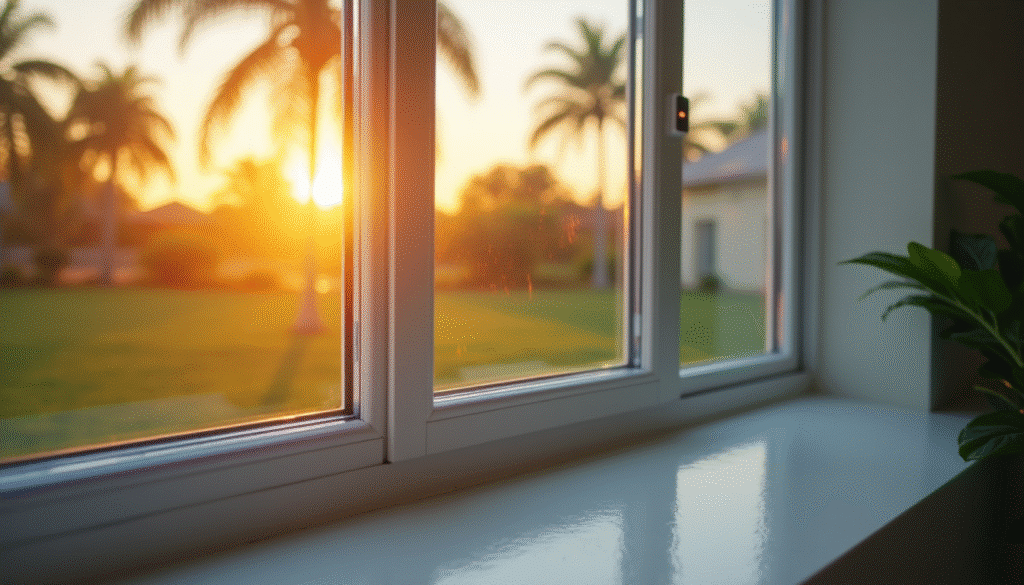
If you live in Florida, your air conditioner is the single biggest contributor to your electric bill, and your windows are a big part of why it works so hard. Standard windows that perform fine in Ohio or Pennsylvania can cost you hundreds of dollars a year here, because they were never designed for 90-degree summers, 80% humidity, and the kind of UV exposure that fades furniture in a single season.
This guide explains what energy-efficient windows actually are, what makes them work in Florida specifically, what they cost, and what kind of savings you can realistically expect. By the end, you'll know exactly what to ask for when you request a quote — and what to walk away from.
What Makes a Window "Energy-Efficient" in Florida?
An energy-efficient window keeps heat out of your house in summer and (less critical here) keeps it in during the few cold weeks of winter. It does this through a combination of multiple panes of glass, special coatings, insulating gas between the panes, and a tightly sealed frame.
In Florida, the priority is heat rejection. Anywhere north of about Atlanta, manufacturers tune their windows to retain interior heat. In Florida, you want the opposite — windows tuned to reflect solar heat outside before it ever enters your home. That's why a window labeled "energy-efficient" in a national catalog might still underperform here. The label is meaningful only when the underlying ratings are calibrated for our climate zone.
Every legitimate energy-efficient window comes with a National Fenestration Rating Council (NFRC) label that tells you exactly how it will perform.
Why Florida's Climate Demands Different Windows
Three climate factors make Florida home windows a special case:
- Sustained heat: Summer temperatures regularly exceed 90°F for months at a time. Your HVAC fights heat almost year-round, unlike northern climates that cycle between heating and cooling.
- Extreme humidity: Average humidity sits between 70% and 80%, especially along the Gulf Coast in cities like Tampa. Windows that aren't sealed properly let moist air seep in, which forces your AC to work harder on dehumidification.
- Intense solar radiation: Florida ranks among the highest U.S. states for solar radiation. Sun pouring through ordinary glass can raise indoor temperatures by 10–15°F in a sunlit room and fade hardwood floors, fabric, and artwork.
Standard windows weren't engineered for this combination. That's the whole reason "energy-efficient windows in Florida" is its own category: what works in the Northeast actively underperforms in St. Petersburg, Miami, or Jacksonville.
The Four Features That Actually Matter
Here are the four specs that determine real-world performance in Florida — these are what to ask about when you request a quote.
1. Low-E Coating
Microscopically thin metallic-oxide layer that reflects infrared heat while letting visible light through. Ask for "southern climate" Low-E.
2. U-Factor (Lower is Better)
Measures heat-flow resistance. Target ≤ 0.30. ENERGY STAR Most Efficient hits 0.27 or lower.
3. SHGC
Solar Heat Gain Coefficient — how much solar heat passes through. Aim for 0.25–0.30. Above 0.40 is wrong for Florida.
4. Argon or Krypton Fill
Inert gas between panes slows heat transfer dramatically. Argon is the sweet spot for most Florida homes.
Florida vs. Northern Specs at a Glance
If you've seen a window quote before and weren't sure whether the numbers were right for Florida, this is the table to bookmark:
| Spec | Florida (target) | North (target) | Why it matters |
|---|---|---|---|
| U-factor | ≤ 0.30 | ≤ 0.27 | Heat-flow resistance |
| SHGC | 0.25 – 0.30 | 0.40+ | Solar heat blocking — biggest factor for Florida |
| Low-E type | Southern climate | Northern climate | Tuned for heat rejection vs. retention |
| Gas fill | Argon (standard) | Argon or Krypton | Slows heat transfer between panes |
Source: ENERGY STAR climate-zone specifications and NFRC ratings.
Best Window Types for Florida Homes
Some window styles handle Florida's climate better than others:
- Casement windows: The crank-out design creates the tightest seal of any operable window — best raw energy efficiency.
- Single-hung and double-hung: The classic choice for Florida home windows. Modern versions with quality weatherstripping perform well and offer the most familiar look.
- Sliding windows: Practical for wide openings and great for bedrooms or coastal-facing rooms in places like Clearwater. Choose models with multi-point locks for the best seal.
- Awning windows: Open outward and upward, letting you ventilate even during light rain without losing your AC.
- Impact-resistant windows: Required by code in Miami-Dade and Broward (the High-Velocity Hurricane Zone). Even where they're not required, they often pay off through insurance discounts and better insulation.
Signs Your Windows Are Costing You Money
Even if your windows look fine from the outside, watch for these signals that they're quietly inflating your power bill:
- You feel a draft or temperature shift when you stand near the window
- Condensation forms between the panes (the seal has failed)
- The frame is hard to operate or no longer locks cleanly
- Outside noise feels louder than it should
- Furniture, flooring, or artwork near the windows is fading faster than expected
- Your summer electric bill keeps climbing without an obvious explanation
If you're seeing two or more of these, it's time to get a quote. Even a partial replacement of the worst offenders typically pays for itself faster than full-house upgrades.
Real Savings: What Florida Homeowners Actually See
Windows account for up to 30% of a home's heating and cooling energy use. According to the U.S. Department of Energy, replacing single-pane windows with energy-efficient models saves between 12% and 33% on annual energy bills.
In Florida, where cooling drives the bulk of your electric bill year-round, those percentages translate to:
- $200–$400 per year: Typical savings for a basic single-pane to double-pane upgrade in an average-sized Florida home.
- Add 10–20% on top: When you include Low-E coatings and inert gas fills.
- $500+ per year: Realistic for larger homes or older window stock — a Sarasota or Orlando customer with 1980s-era windows often sees savings well above this.
Florida homeowners typically recover 20–30% of the window cost through energy savings within 5–10 years. On top of that, energy-efficient upgrades add 5–15% to home value at resale.
What's New in 2026
- Triple-pane is gaining ground: Once considered overkill for Florida, triple-pane windows with proper southern-climate Low-E coatings now make sense for premium new construction and high-energy-cost homes, particularly in markets like Jacksonville.
- Smart glass moving to mainstream: Electrochromic glass that tints automatically based on sun exposure has dropped in price enough that it's appearing in mid-market projects.
- Slim-frame designs: Modern aesthetics demand more glass and less frame, and manufacturers have responded with slim-profile aluminum and fiberglass frames that don't sacrifice insulation.
- Federal tax credits through 2032: Qualifying ENERGY STAR Most Efficient windows can earn a tax credit of 30% of cost up to $600 annually under the Inflation Reduction Act.
How to Choose the Right Energy-Efficient Windows
When you're comparing quotes, focus on five things in this order:
- NFRC label numbers — U-factor ≤ 0.30 and SHGC ≤ 0.30 are non-negotiable for Florida.
- ENERGY STAR certification — specifically certified for the Southern Climate Zone, not generic ENERGY STAR.
- Frame material — vinyl, fiberglass, and thermally broken aluminum all work; uninsulated aluminum doesn't.
- Installation quality — even the best window underperforms if it's installed poorly. Ask about flashing, sealing, and how the installer handles humidity issues.
- Warranty terms — at least 10 years on glass seal failure and lifetime on the frame.
If a quote skips over the NFRC numbers or won't give you specifics, that's a sign to keep shopping.
Frequently Asked Questions
How much do energy-efficient windows cost in Florida?
What U-factor and SHGC should I look for in Florida?
Are energy-efficient windows worth it in Florida?
Do I qualify for tax credits on new energy-efficient windows?
Are impact windows the same as energy-efficient windows?
How long do energy-efficient windows last in Florida?

[Author Name]
[Author has X+ years of experience installing impact and energy-efficient windows across Florida. Specializes in NFRC ratings, climate-zone certification, and installation in coastal environments. Based in St. Petersburg.]
Ready to See What You'd Save?
Energy-efficient windows aren't a one-size-fits-all purchase in Florida. Your home's sun exposure, your county's code requirements, and your specific energy goals all shape the right answer. Every quote we provide is built specifically for your home — not a generic estimate.