Financing available. Click here to learn more ⟶
Financing available. Click here to learn more ⟶
Florida Hurricane Window Code by County: Guide
Florida’s hurricane window code isn’t one set of rules; it’s 67 different realities. The Florida Building Code applies statewide, but wind zones, HVHZ status, permitting processes, and inspection requirements vary significantly by county. A homeowner in Miami-Dade faces stricter impact testing requirements than one in Orange County, and that variation directly affects what’s required in your home and what you’ll pay for it. This guide breaks down what actually applies in each Florida county we serve, including current wind zone designations, whether your county falls under HVHZ rules, permit timelines, and the specific code sections that govern your installation.
The Florida Building Code (FBC) is a single statewide standard, currently in its 8th edition (effective December 31, 2023). The 9th Edition takes effect December 31, 2026. So why does what’s required in Miami look so different from what’s required in Orlando?
Three reasons:
• Wind zones differ geographically. FBC Section 1609 governs wind loads and references the ASCE 7-22 wind speed maps. Those maps assign different design wind speeds to different parts of the state; coastal counties see higher numbers than inland counties because they sit closer to where hurricanes make landfall.
• HVHZ adds a separate overlay. The High-Velocity Hurricane Zone is a distinct designation that applies only to Miami-Dade and Broward counties. HVHZ requirements live in FBC Section 1620 and impose stricter testing and product-approval rules than the rest of the state.
• Local amendments allow stricter rules, never weaker ones. Counties and municipalities can layer additional requirements on top of the FBC. They cannot weaken the statewide minimum. This is why the same window product may be code-compliant in one county and rejected in another.
What this means in practical terms: code dictates which windows are legal for your address, what permits will cost you, and what insurance discounts (such as those available through Citizens Property Insurance and many private carriers) you may qualify for. Get it wrong and you face failed inspections, voided coverage, or both.
For the official source, see the Florida Building Commission.
A “wind zone” in Florida is shorthand for the design wind speed assigned to your address. The FBC 8th Edition adopts ASCE 7-22 as the wind load standard, replacing the older ASCE 7-16 that the previous edition referenced.
The categories that matter for residential work:
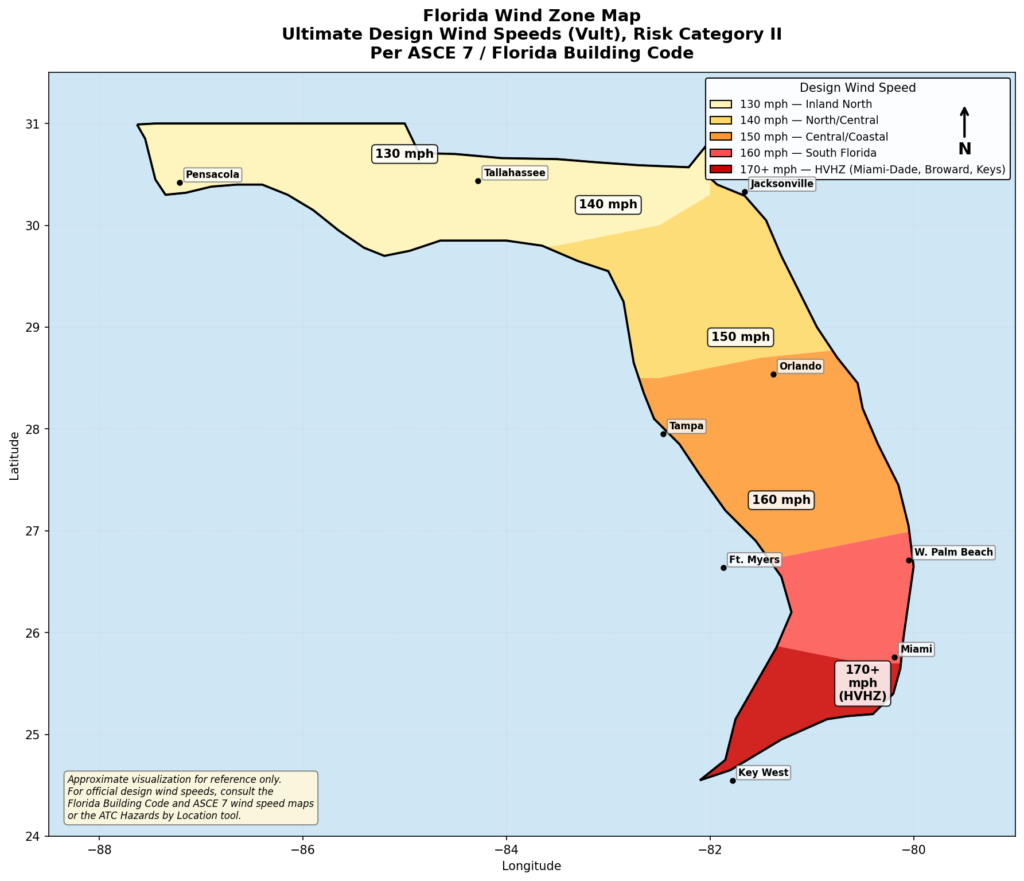
Wind speeds are quoted as 3-second gusts at 33 feet above ground in Exposure C (open terrain), Risk Category II (typical residential occupancy). Risk categories III and IV, schools, hospitals, and emergency facilities use higher numbers.
Those wind speeds translate directly into design pressure (DP) ratings for your windows. A DP rating tells you how much positive (inward) and negative (outward suction) pressure a window can withstand. A window rated DP +60/−60 is engineered for substantially higher wind loads than one rated DP +35/−35. Your window’s DP rating must meet or exceed the calculated design pressure for your specific opening, which depends on wind speed, building height, exposure category, and the location of the opening on the wall (corners and edges see higher pressures than the middle of a wall).
Wind-Borne Debris Region (WBDR) is a separate trigger. Under ASCE 7-22, the WBDR generally captures locations where the design wind speed is 140 mph or higher and any location within one mile of the coast where the wind speed is 130 mph or higher. ASCE 7-22 also expanded the WBDR to capture inland areas adjacent to large lakes and bays that meet “Exposure D” conditions. If your property falls in the WBDR, impact-rated glazing or approved shutter protection is required for new construction and most substantial renovations.
To verify the design wind speed for a specific address, the [ASCE 7 Hazard Tool] and the [University of Florida GeoPlan wind speed map viewer] both work. For federal context on hurricane wind hazards, see FEMA Building Science.
Every window installed in HVHZ must carry a Notice of Acceptance (NOA). An NOA is a formal product approval issued by the Miami-Dade Product Control Division certifying that the window has passed the HVHZ test protocols. State-level Florida product approval is not enough by itself in HVHZ, products must specifically carry HVHZ approval. You can verify any product’s NOA at Miami-Dade Product Control Search.
Test standards are tougher. HVHZ products are tested per TAS 201, 202, and 203 (Testing Application Standards), which include large missile impact testing. The protocol fires a 9-pound, 2-by-4 lumber projectile at 50 feet per second at the glazing, twice, followed by 9,000 cycles of pressure to simulate sustained hurricane winds. These protocols align with ASTM E1886 and ASTM E1996 but apply HVHZ-specific acceptance criteria.
Cost runs 30–50% higher. HVHZ-rated windows cost meaningfully more than equivalent windows for non-HVHZ installations because of the additional engineering, testing, and certification. That premium is one of the realities. Miami homeowners face the strictest impact window requirements in the U.S., and we cover this in detail in our Miami service area guide.
The “30% Rule” matters for renovations. In HVHZ, if you replace more than 30% of your home’s openings or alter more than 30% of the building envelope, the entire envelope generally must be brought up to current HVHZ standards. This catches a lot of homeowners off guard during whole-house window replacement projects.
The 9th Edition of the FBC, taking effect December 31, 2026, expands some HVHZ-style requirements beyond Miami-Dade and Broward, see the 2026 updates section below.
| Spec | Requirement | Why it matters ✎ | |
|---|---|---|---|
| Wind zone (Risk Cat II) | 175 mph | Ultimate design wind speed for HVHZ structures | |
| HVHZ | Yes | High-Velocity Hurricane Zone, strictest wind standards in the U.S. | |
| Required product approval | Miami-Dade NOA | Notice of Acceptance required for all exterior products | |
| Impact test standard | TAS 201/202/203 (large missile) | Verifies impact, cyclic, and air/water performance | |
| Permit timeline (typical) | 4–6 weeks | Verify with current Miami-Dade Building Department experience | |
| Code section | FBC Section 1620 | Florida Building Code provisions for HVHZ wind loads | |
Source: Florida Building Code (FBC) and Miami-Dade County Product Control Section.
Miami-Dade is the strictest jurisdiction in the country for residential window installation. Every product must carry an active NOA, every installation must be permitted, and inspections are enforced rigorously. A Notice of Commencement is required for any project over $2,500 (Florida Statute § 713.13). There is no informal path; DIY installations almost universally fail final inspection because they cannot produce installation engineering signed and sealed by a Florida-licensed engineer matching the NOA installation method.
For homeowners, the trade-off is real: Miami-Dade enforcement is genuinely protective. The county’s windows are the most thoroughly tested fenestration products available in North America.
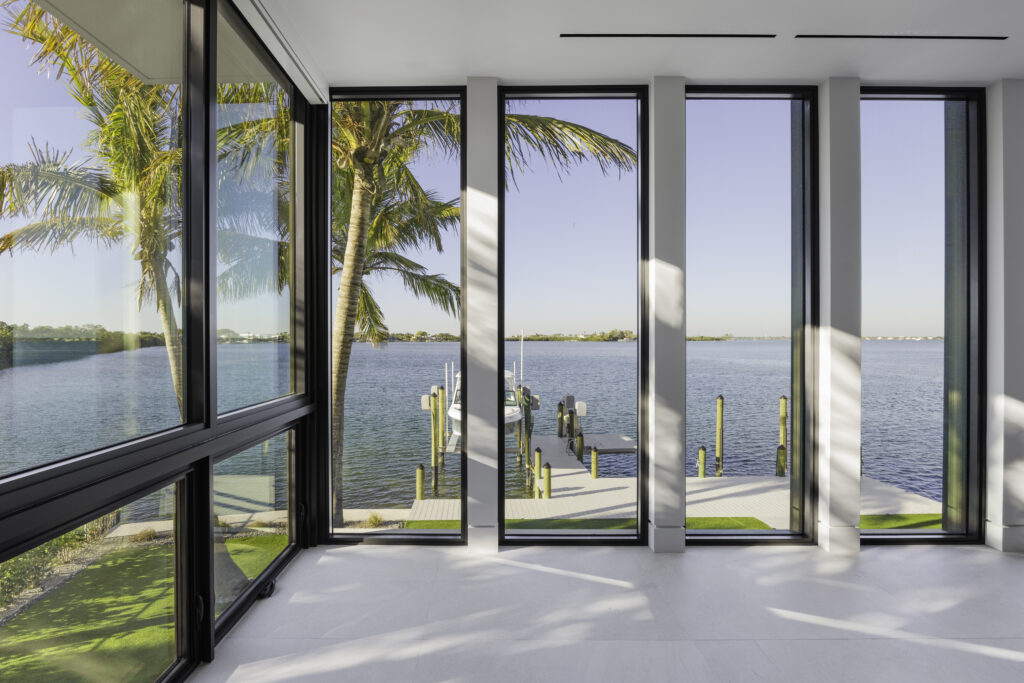
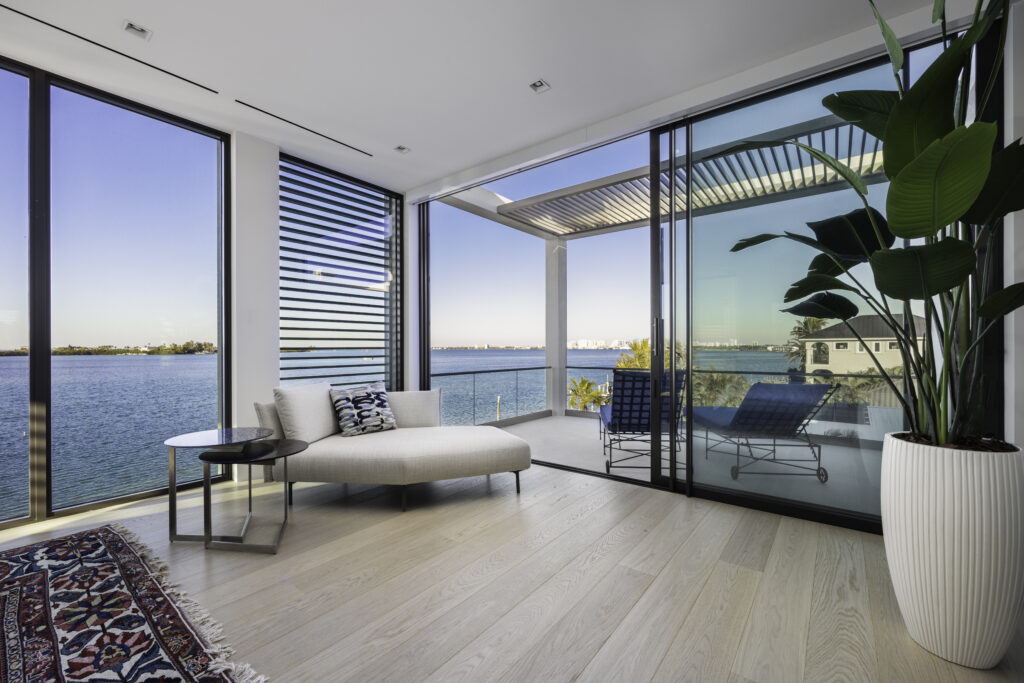
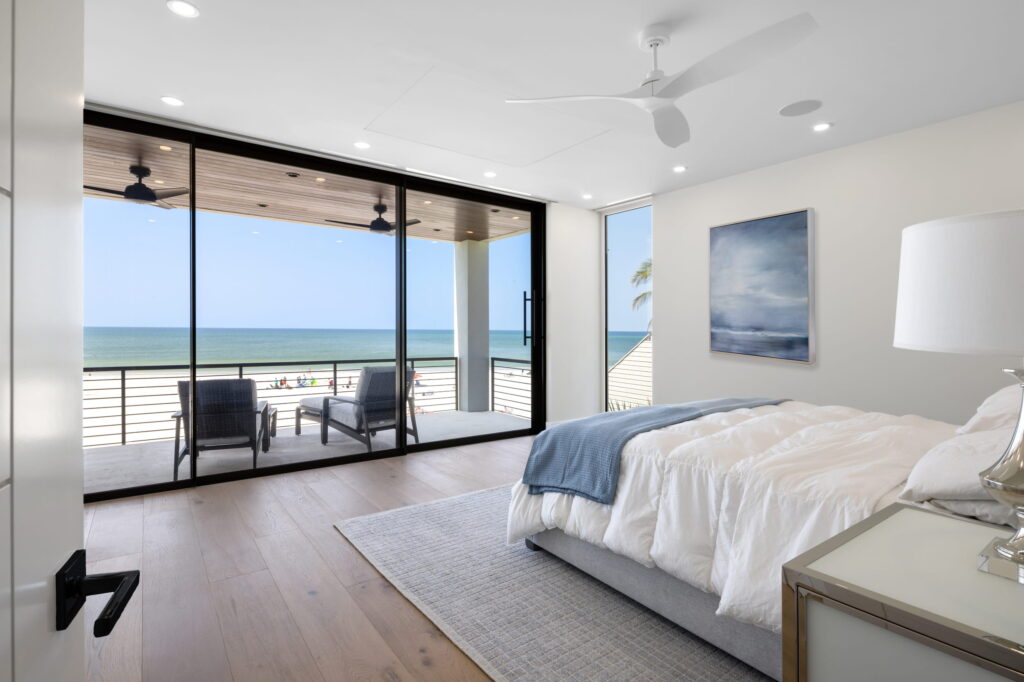
In 2025, installed windows and doors; the inspector required revised installation diagrams when the buck depth varied from the NOA spec by 1/8 inch. That level of enforcement is normal here, not exceptional.
| Spec | Hillsborough County (target) | Why it matters ✎ |
|---|---|---|
| Wind zone (Risk Cat II) | ~150 mph (varies by location) | Ultimate design wind speed for the Tampa Bay region |
| HVHZ | No | Outside the High-Velocity Hurricane Zone — standard FBC wind provisions apply |
| Required product approval | Florida Product Approval | Statewide approval system for exterior building products |
| Impact test standard | ASTM E1996 / E1886 | Validates impact resistance for windborne debris regions |
| Permit timeline (typical) | [INSERT: Verify with current Hillsborough County permit experience] | Timelines vary by project scope and current department workload |
| Code section | FBC Section 1609 | Florida Building Code provisions for general wind loads |
Source: Florida Building Code (FBC) and Hillsborough County Building Services.
Hillsborough County sits in the Wind-Borne Debris Region, which means impact-rated glazing or approved shutter protection is required for new construction and most window replacements. State-level Florida product approval governs here; no NOA required, though many manufacturers carry both. Permits are issued through Hillsborough County’s Development Services Department, with separate jurisdictional permitting inside the City of Tampa, Temple Terrace, and Plant City.
A note specific to Tampa Bay: storm surge zones overlap with much of the residential coastline. While the FBC governs wind loading on the structure, FEMA flood zone classification can drive separate elevation and floodproofing requirements that intersect with how windows are installed.
For homeowners researching window replacement in Tampa, FL, our service area page covers permit fees, the rough-opening inspection sequence, and product options that meet local design pressure requirements.
| Spec | Pinellas County (target) | Why it matters ✎ |
|---|---|---|
| Wind zone (Risk Cat II) | ~150 mph (peninsula); higher in coastal exposure | Ultimate design wind speed; coastal exposure increases load demands |
| HVHZ | No | Outside the High-Velocity Hurricane Zone, standard FBC wind provisions apply |
| Required product approval | Florida Product Approval | Statewide approval system for exterior building products |
| Impact test standard | ASTM E1996 / E1886 | Validates impact resistance for windborne debris regions |
| Permit timeline (typical) | [INSERT: Verify with current Pinellas/St. Pete/Clearwater permit experience] | Timelines vary across Pinellas County, St. Petersburg, and Clearwater jurisdictions |
| Code section | FBC Section 1609 | Florida Building Code provisions for general wind loads |
Source: Florida Building Code (FBC) and Pinellas County / St. Petersburg / Clearwater Building Departments.
Pinellas is fully inside the windborne debris region. Because the entire county is a narrow peninsula, virtually every neighborhood, including Snell Isle, Old Northeast, Shore Acres, Tierra Verde, Indian Rocks Beach, and Dunedin Causeway, sits within five miles of tidal water. That matters for the 9th Edition changes coming December 31, 2026 (covered below), which expand 160 mph envelope requirements to new construction within five miles of tidal water.
Permits are issued through three separate jurisdictions depending on the property: unincorporated Pinellas County, the City of St. Petersburg, and the City of Clearwater (each with its own building department). Beach municipalities (Indian Shores, Madeira Beach, and Treasure Island) issue their own.Don’t assume one set of forms covers the requirements of another jurisdiction.
St. Petersburg’s coastal exposure pushes design pressures higher than the inland mainland; corner windows and upper-floor openings on barrier islands will see DP requirements at the upper end of what residential products carry. Clearwater Beach impact windows face the same constraint.
| Spec | Sarasota County (target) | Why it matters ✎ |
|---|---|---|
| Wind zone (Risk Cat II) | 150–160 mph (varies; coastal higher) | Ultimate design wind speed; coastal exposure increases load demands |
| HVHZ | No | Outside the High-Velocity Hurricane Zone — standard FBC wind provisions apply |
| Required product approval | Florida Product Approval | Statewide approval system for exterior building products |
| Impact test standard | ASTM E1996 / E1886 | Validates impact resistance for windborne debris regions |
| Permit timeline (typical) | [INSERT: Verify with current Sarasota County permit experience] | Timelines vary by project scope and current department workload |
| Code section | FBC Section 1609 | Florida Building Code provisions for general wind loads |
Source: Florida Building Code (FBC) and Sarasota County Building Department.
Sarasota County window installation operates inside the Wind-Borne Debris Region. The county was significantly affected by Hurricane Ian (2022), and post-Ian damage assessments influenced both the 9th Edition code revisions and how local inspectors verify installation methods. Permits run through Sarasota County for unincorporated areas; the City of Sarasota and Town of Longboat Key (the Sarasota County portion) handle their own.
Barrier island properties: Siesta Key, Lido Key, and Casey Key, face Exposure D conditions on water-facing elevations, which raises design pressures meaningfully above the same product on a sheltered mainland lot.
| Spec | Orange County (target) | Why it matters ✎ |
|---|---|---|
| Wind zone (Risk Cat II) | ~130 mph | Ultimate design wind speed for inland Central Florida |
| HVHZ | No | Outside the High-Velocity Hurricane Zone, standard FBC wind provisions apply |
| Required product approval | Florida Product Approval | Statewide approval system for exterior building products |
| Impact test standard | ASTM E1996 / E1886 (where WBDR applies) | Validates impact resistance in designated Windborne Debris Regions |
| Permit timeline (typical) | [INSERT: Verify with current Orange County permit experience] | Timelines vary by project scope and current department workload |
| Code section | FBC Section 1609 | Florida Building Code provisions for general wind loads |
Source: Florida Building Code (FBC) and Orange County Building Division.
Inland Florida window replacement in Orlando looks different from coastal work. Orange County sits at the lower end of the residential design wind speed range, and most of the county falls outside the wind-borne debris region, which means impact-rated windows are often optional for replacement, not required. They remain a strong recommendation: even at 130 mph design wind speed, central Florida sees significant hurricane exposure, as Hurricane Charley (2004) and Hurricane Ian (2022) demonstrated.
The expansion of the WBDR in ASCE 7-22 to include inland areas near large lakes such as Lake Apopka, the Butler Chain, and Lake Conway caught some homeowners by surprise during the 8th edition transition. Check your specific address; lakeside properties in Orange County may now require impact glazing where they previously did not.
Permits are issued through Orange County for unincorporated areas; the City of Orlando inside city limits, and several smaller municipalities (Winter Park, Maitland, Belle Isle, and Windermere) for their territories.
North Florida window installation requirements are real but lower in intensity than South Florida. Duval County’s coastal strip, Atlantic Beach, Neptune Beach, Jacksonville Beach, and Mayport are in the wind-borne debris region and require impact-rated glazing for new construction. Western Duval and the consolidated Jacksonville mainland generally see lower design wind speeds and frequently fall outside the WBDR.
Jacksonville’s consolidated city-county government means most permitting routes through a single building inspection division, which simplifies one part of the process compared with the multi-jurisdiction reality in Pinellas. Beach municipalities still handle their own permits.
A planning note: hurricane risk in North Florida is genuinely lower than in South Florida, but it is not zero. Hurricane Matthew (2016) and Hurricane Irma (2017) both produced damaging winds in Duval. Impact windows are uncommon outside the coastal strip, which is a market reality, not a code requirement.
Notice of Commencement is required for any project over $2,500. This is Florida Statute §713.13. The NOC must be recorded with the county clerk before work begins and posted at the job site. Skip this and your contractor can be barred from filing a lien, but more relevantly for homeowners, your final inspection can be held until it is recorded.
Inspections happen in three stages. A typical impact window job sees a rough opening inspection (after demo, before install), an installation inspection (after the windows are set but before trim), and a final inspection. HVHZ counties may add additional verification steps tied to the NOA installation method.
DIY installation usually fails inspection. Florida product approvals and NOAs include specific installation instructions, anchor type, anchor spacing, buck depth, sealant specification, and shim placement. Inspectors verify the installation matches those instructions. A correctly chosen window installed incorrectly will fail the inspection and the warranty.
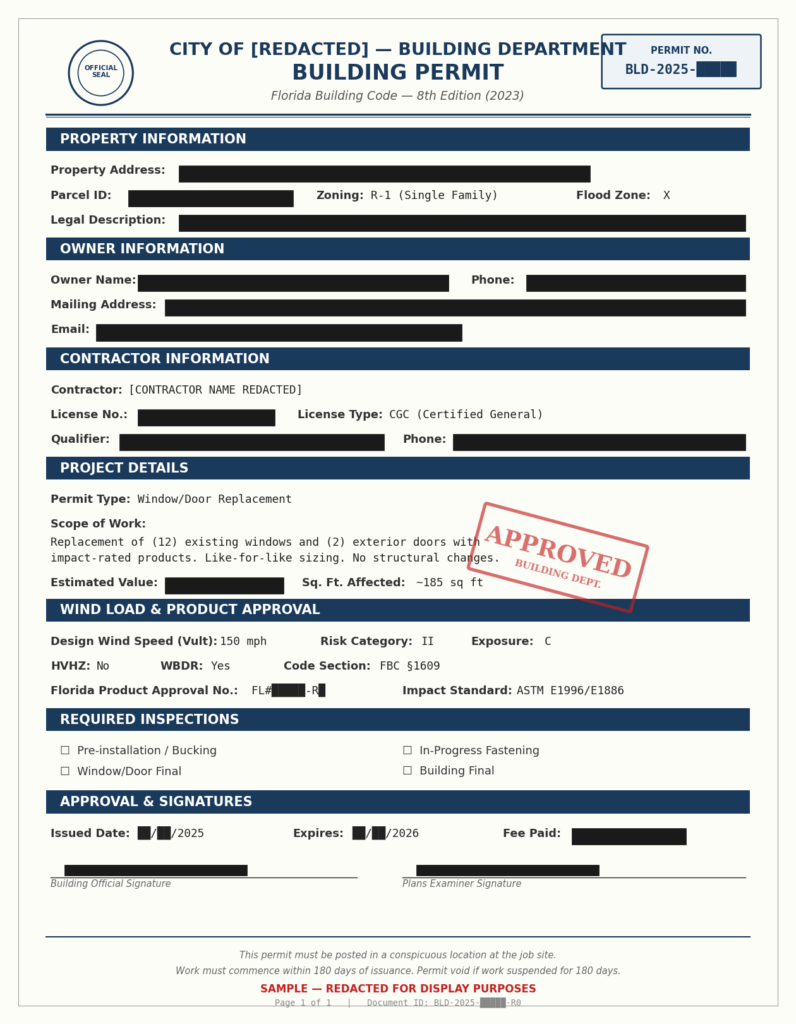
A five-step process that works for any Florida address:
For the official statewide search, see the Florida Building Code Online product approval search.
The Florida Building Code 9th Edition takes effect December 31, 2026, replacing the 8th Edition (2023). Several changes affect residential window installation directly.
ASCE 7-22 stays in place as the wind load standard. The 8th Edition already adopted ASCE 7-22 (a change from ASCE 7-16 in the 7th Edition), so the structural calculation methodology does not change at the December 31 transition. What does change is product approvals: products tested under 8th Edition acceptance criteria may need re-testing for the 9th Edition.
HB 911 expands 160 mph envelope requirements beyond traditional HVHZ. House Bill 911 and companion Senate Bill 1218, if enacted, direct the 9th Edition to require impact-resistant building envelopes capable of resisting at least 160 mph wind events for several categories: multistory residential buildings (R-1 and R-2 occupancies), new residential construction within five miles of tidal waters, and new construction inside the existing HVHZ. The “five miles of tidal water” language captures most of coastal Florida, including essentially all of Pinellas County, large portions of Hillsborough and Sarasota, the Miami-Dade and Broward coastline, and the Duval coastal strip. As of this writing, the legislative status remains under review; verify the final 9th Edition language at [floridabuilding.org] before relying on the specific scope.
The energy code tightens. The 9th Edition aligns with IECC 2024, which lowers maximum Solar Heat Gain Coefficients (SHGC) for vertical glazing in Florida’s climate zones. For Climate Zones 1 and 2, the maximum SHGC for glazed vertical fenestration is 0.25. In practical terms, the same physical window with a different low-E coating may pass under the 8th Edition and fail under the 9th Edition energy compliance path.
The “25% roof replacement rule” relaxes. Under the old rule, replacing more than 25% of a roof triggered a full code-compliance upgrade for the entire roof. The 9th Edition allows partial roof recovery under defined conditions. This is a roofing change, not a window change, but it matters for whole-envelope renovations.
Permit timing matters. Under Florida Statute §553.73(7)(e), a code edition becomes enforceable on its effective date, December 31, 2026, for the 9th edition. Permits pulled before that date are generally locked into 8th Edition rules through completion. Permits pulled after are subject to 9th Edition rules. If you have a project planned for late 2026 / early 2027, the timing of when the permit is filed materially affects what your windows must meet.
Existing installations are generally grandfathered; a window that met code at the time of permitted installation does not become non-compliant when the code updates. The exception is the HVHZ 30% rule, which can pull the entire envelope into current code if substantial alterations are made.
Florida’s hurricane window code is a layered system: a statewide FBC, an ASCE 7-22 wind speed map, an HVHZ overlay for two counties, a Wind-Borne Debris Region trigger that depends on wind speed and proximity to water, and local amendments that can tighten any of it. The result is that the same window product can be perfectly legal in Orlando, marginal in Tampa, and rejected in Miami, and that’s working as intended.
The complexity isn’t going to go away. The 9th Edition takes effect December 31, 2026, and will tighten the rules further, particularly for properties within five miles of tidal water. If you’re planning a window replacement project in Miami-Dade, Hillsborough, Pinellas, Sarasota, Orange, or Duval counties, the value of working with someone who installs in your specific jurisdiction every week is that they already know which products carry current approvals, which inspectors look for which details, and what the realistic permit timeline is right now, not what it was last year.
HVHZ stands for High-Velocity Hurricane Zone. It is a designation that applies only to Miami-Dade and Broward counties and triggers stricter testing, product approval, and installation requirements than the rest of the state. HVHZ rules are in FBC Section 1620.
No. Impact-rated glazing is required in the Wind-Borne Debris Region, which generally covers coastal counties and inland areas with high design wind speeds. Inland counties with design wind speeds below 130 mph and outside the WBDR may not require impact glazing for replacement projects, though new construction rules vary.
Use the ASCE 7 Hazard Tool or the University of Florida GeoPlan wind speed map viewer. Both let you enter a street address and return the design wind speed under ASCE 7-22, which is the standard the current FBC uses.
The FBC sets the statewide minimum. Counties and municipalities can add stricter requirements through local amendments, they cannot weaken the FBC. Always check both the FBC and your local jurisdiction's amendment list.
The FBC is updated on a three-year cycle. The 8th Edition took effect December 31, 2023; the 9th Edition takes effect December 31, 2026. Mid-cycle amendments and product approval revisions happen continuously; verify before purchase.
It depends on location. If your property is in the Wind-Borne Debris Region, replacement windows generally must be impact-rated or paired with approved shutter protection. In HVHZ, replacement projects involving more than 30% of the building envelope can trigger full HVHZ compliance for the whole envelope. Outside the WBDR, replacement is usually unrestricted by impact requirements, though local amendments may add rules.

If you’re researching window replacement in a specific Florida city, our service area pages break down the local code, permit process, and pricing in detail. Contact us and schedule your complimentary quote, and we’ll walk you through what your county requires and what it means for your home.






Copyright © 2026 All Rights Reserved.